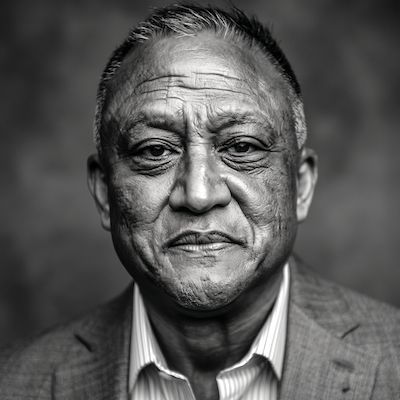
I lived on the rise of a hill facing west, right outside the Āliamanu Crater, on Keaka Drive. From our living room window, we could see parts of Pearl Harbor, Ewa, and Waipahu, and further out, Makakilo, rising and becoming the Waiʻanae Mountain Range. In the culture of Hawaiʻi, the color of our house told you everything about its occupants. It was pink and green, mostly pink.
Filipinos lived there, which is a stereotype I still find funny.
It was a typical 80-degree summer day, and I was ten years old, sitting on a stool in the shade of a large mango tree, trying very hard not to scratch my neck, the inside of my elbows, or the backs of my knees. If you have ever lived with eczema, you know the urge to scratch is vampiric, because the bliss you feel while scratching is what it must be like when the need for blood is finally satisfied.
This was my eczema cycle, every day and every night. I was hyper-vigilant from the moment I woke up until my eyes closed. I didn't want this to define who I was. I didn't want visible scars. I didn't want to deal with the pain. The medications I was prescribed were strong, and the long-term harm to my body was substantial, but being ten, I didn't know any of that, so we used a lot of it, even though it never eliminated the urge to scratch, it just made things easier after the fact.
The only thing that actually worked was cold water therapy.
In Hawaiʻi, artesian aquifers run deep underground, so when you turn on the spigot, the water from the hose is very, very cold. I made cold wraps from bandanas to cool my neck during chores. I used the hose to calm my skin when the urge became unbearable. I took cool showers daily. I slept on a damp towel with a fan running on hot nights. In wintertime, I slept with the windows open. This was my normal.
I was the youngest of seven kids. Growing up in Hawaiʻi, my days were simple: once homework and chores were done, I could be found playing outside with friends in the hot afternoon sun or drawing superheroes and cars on the living room coffee table. Summers meant the beach in our 1968 Ford Ranch Wagon, touch football in the street, and shooting hoops in front of the neighbor's garage. We competed barefoot or in rubber slippers on hot asphalt. Sneakers wouldn't be a thing for another 15 years.
After graduating from a local college prep school, I headed to art school in Oakland, California.
By nineteen, I had developed into a serious athlete. I started showing up at open gyms in Oakland and Berkeley to play volleyball, caught the attention of the men's volleyball coach at UC Berkeley, and was eventually recruited to play for a Junior Olympic boys' 19-and-under team out of Concord, California. I was all of 5'3" with a 42-inch vertical leap. In 1982, I played in the National Junior Olympic Volleyball Championships in Santa Barbara, California, placed third, and kept competing at a high level until 2012, when the frequency of inflammation and pain in my legs made it impossible to continue.
My last national event was the USAV Open National Championships in Minneapolis in 2009. We took bronze in the 45-and-over division.
For 56 years, I battled eczema. For 16 years, I dealt with joint inflammation in my lower limbs: episodic, unpredictable, and personally devastating for someone who loves to compete. And from about 2001 to 2018, I quietly struggled with episodes of choking on food.
That last one was my secret. I never told anyone. The funniest thing about it: no one ever witnessed me throwing up. Not my family. Not my friends. The gastroenterologist didn't know what it was or what caused it. When they don't have a name for something, they file it under autoimmune.
On Father's Day 2014, I dined on prime rib cut into tiny pieces and still ended up in the ER. The irony was I never choked on food from McDonald's or Burger King, only the expensive stuff. To eat my favorite food, pasta Bolognese, I had to blend it into a soup, so I made a batch every week. There were days I felt that I wouldn't see a day past 55, the age my father died, and I could do nothing to stop it. The last doctor I saw called for an endoscopy and decided I had an allergy, though he didn't know to what, and gave me an inhaler meant for asthma. That didn't work either.
The only thing connecting these three conditions (the eczema, the joint inflammation, the choking) was that they were all happening to me, and modern medicine had no explanation for the inflammation or the choking.
By 2012, my daily routine looked like this.
I carried a large backpack everywhere. Inside it: prescription corticosteroids to prevent itching, over-the-counter corticosteroids as backup, two bandanas to cool my neck, ten handkerchiefs for sneezing, one instant cold pack, one Ziploc bag for ice, three rolls of ace bandages for cold compresses when my knees, ankles, or feet flared up, a bottle of Celebrex for the pain, a change of clothes, and a telescoping carbon fiber walking stick in lieu of crutches.
For the choking, I needed no tools. I had learned to manage that one on my own.
Predicting what would trigger an inflammation event was the hardest part. And even when I managed to get it under control, two to two-and-a-half weeks passed before I could walk normally again. Every. Single. Time.
I told myself the years of jumping had simply worn me down, a reasonable cost for a long athletic life. But I didn't really know. And clearly, neither did the doctors, none of whom ever gave me a diagnosis, despite every specialist available.
In 2014, my family started a cannabis processing company. We produced full-spectrum, terpene-rich oils from sun-grown cannabis, a business venture that became an unintentional personal health journey.
I wasn't consuming THC or CBD as a wellness practice. I wasn't following a protocol or tracking outcomes. As we built the company, I was simply present, while my team extracted cannabis oil, handled flower, and produced our award-winning product daily. The exposure was frequent and full spectrum, meaning it included both CBD and THC, along with all the terpene aromatics from every strain we were working with. And it was, looking back, the only meaningful variable that changed in my life during those years.
I didn't notice the shift happening. I was too busy building a business.
One day in the fall of 2018, I was out delivering product to stores in Vancouver, Washington. It was hot and sunny, and I drove with the windows down, because the weather in the Pacific Northwest always reminds me of Hawaiʻi.
On the road to my first delivery, I realized I wasn't sneezing or sniffling.
As I drove back toward Kirkland, I tried to remember the last time I had scratched my neck, my arms, my legs. I hadn't choked on food in a while. And it had been at least two months since my last inflammation event.
I passed the Tacoma Dome and decided to stop at Southcenter Mall to eat. I stepped out of the delivery van and took a deep breath. Still, no sniffling, no sneezing, or even watery eyes. I ordered teriyaki beef over noodles from Sarku. I ate it without incident.
I sat with that for a long time.
By 2019, I was effectively itch-free and choke-free. My last meaningful inflammation event was October 2022. I have not had one since.
I use the word "meaningful" deliberately, because on May 22nd, 2026, I felt the precursor: the familiar signal in my left ankle, the one that, for sixteen years, announced what was coming. Days of swelling, ice packs, ace bandages, the walking stick. Two to two-and-a-half weeks before I could move normally again.
Out of habit, I applied my pain gel, made sure I still had Celebrex just in case, then I went to sleep.
The next morning, there was a little inflammation, but my shoe still fit. Typically, when I'm in full-blown inflammation, no shoe fits and the skin is hot and any pressure is an 8 on the pain scale. This time, the precursor signal arrived, my body registered it, and it resolved almost all of it overnight, the way a healthy regulatory system is designed to.
This is what a body rebuilt from the inside looks like in practice. Not the absence of a signal, the signal still comes. But the absence of the cascade of inflammation and pain that typically follows. The body registers the threat, deploys its own resolution chemistry, and returns close to baseline without the two-week shutdown that used to be mandatory so my body could heal.
Sixteen years of two-and-a-half week recoveries. Then a familiar signal comes along, and my shoe still fits the next morning?
Not because I took something in time to block the signal, but because something inside me had been built back and was now working properly. I call that the substrate. A healthy substrate works tirelessly to keep the body and mind in homeostasis.
This is the transformation I'm trying to explain.
Looking back, one truth is clear: it wasn't cannabis that cured me. It wasn't CBD that fixed me.
For decades, my body had been unable to efficiently communicate within itself, until the repeated nightly input of THC helped it rebuild CB1 and CB2 receptor sites, enabling the on-demand creation of anandamide and 2AG, the two most important chemical messengers in human biology. Unlike other chemical messengers, they are made on demand and their responsibilities are broad.
In other words, my body was unable to respond correctly for decades, and because my ECS was restored, it finally responded, consistently and effectively, resolving my allergies, eczema and now able to dial down both pain and inflammation from within.
The endocannabinoid system or ECS is the body's master regulatory network, synthesizing anandamide and 2AG on demand, to govern inflammation, pain, immune response, sleep, metabolic function, and stress. Mine had been depleted for decades. Not broken. Depleted.
What cannabis did was re-ignite the system. Not overnight. Over 1,825 days. Because I didn't just need relief. I needed new receptor sites built, new pathways forged, and something like trust restored inside my own biology. If I knew back then what I know now, it would've taken 8 months.
The neuroscientist Dr. Lisa Feldman Barrett describes how the brain constructs experience through prediction, using past sensation, memory, and context to anticipate what's coming next. The brain stops predicting pain when the evidence changes. It starts predicting calm when calm becomes the more frequent pattern.
My brain eventually stopped predicting inflammation. It started predicting resolution. That shift didn't happen through willpower. It happened through biology, slowly, invisibly, until the day I drove through Vancouver with the windows down and realized something essential inside of me had changed.
I share this not to sell you something. I share it because living inside this part of my story for so long taught me what no one else could: what it costs to carry chronic pain through a life, and what it feels like when the body finally returns to itself.
Most of us trust doctors and the pharmaceutical industry to a fault, even though medical science probably understands well under 20% of the total complexity of the human body. Some areas are nearly complete. Others, like how the body communicates within itself, how the immune system integrates with the microbiome, and how the regulatory systems governing pain and inflammation work, remain mostly unknown, even as they determine the quality of every day we live.
That gap is where I work.
Not with protocols built from books, but with a framework built from living, refined by science, grounded in what happened inside one body over time. My body.
If you are living with pain, with inflammation, with conditions that have been named but not resolved, I want you to know that the gap between where you are and where your body is capable of going may be smaller than you think, or what you've been told.
The walking stick, the ice packs, the bandanas, the Celebrex: they still sit on a shelf in my home. Not because I'll never need them. But because I know now what I didn't know then: the body I was given was designed to heal. It just needed me to understand fully how it works, why it works and how that knowledge helps me make better decisions for myself.
What I discovered 2.5 months ago is that we don't need THC or CBD to make sure the ECS does one of the most important jobs in our biology, 24/7/365. We can rebuild the ECS ourselves, and once you understand how, you can finally take control of what you eat, how you exercise, and how you choose to rest and recover. Right now, I'm the only one who understands this, and I want to proliferate this knowledge and help as many people as I can.
This knowledge has real consequences for personal health and wellness goals by putting you, the individual in charge. Whether the goal is to be healthy, to compete, to lose weight, or to regain mobility, you will know what to do and how to do it.
This new knowledge changed how I understood the underlying engine within my body that shows up for me, faithfully, every day, and how to feed it so it runs the way it was built to. Which is exactly why I consider the body heroic and why my protocol is the path to self-health restoration.
I'm not the only one. There are many others like me,
and I built this protocol for them.
If that's you, I invite you to contact me directly.
Mahalo for reading.